
The global demand for Indian vegetables is growing rapidly in 2026, making proper export packaging more important than ever. Exporters who fail to use the right packing techniques often face spoilage, rejection, reduced shelf life, and financial losses. To maintain freshness during long-distance transportation, businesses must follow strict packaging, handling, and shipping standards.
In this guide, we explain how to pack vegetables for export using modern methods that help maintain product quality, prevent damage, and meet international import requirements.
Why Proper Vegetable Export Packaging Matters
Fresh vegetables are highly perishable products. Temperature fluctuations, excess moisture, rough handling, and poor ventilation can quickly reduce quality during transit.
Professional export packaging helps:
- Preserve freshness and texture
- Reduce physical damage
- Improve shelf life
- Maintain hygiene standards
- Meet international import regulations
- Increase buyer satisfaction
- Reduce rejection rates at destination ports
Whether exporting onions, potatoes, green chillies, okra, or leafy vegetables, packaging quality directly impacts profitability.
How to Pack Vegetables for Export Successfully
The export packaging process begins long before the vegetables are placed inside cartons or bags. Every stage matters.
Step 1: Select Export-Quality Vegetables
Only premium-grade vegetables should be packed for export.
Export-quality vegetables should be:
- Freshly harvested
- Free from cuts and bruises
- Uniform in size and color
- Free from pests and fungal infections
- Properly matured
Sorting and grading help create consistency, which international buyers expect.
Step 2: Cleaning and Pre-Cooling Process
Vegetables should be cleaned carefully to remove:
- Soil
- Dust
- Pesticide residue
- Surface bacteria
After cleaning, pre-cooling becomes essential. This process removes field heat and slows down spoilage.
Common Pre-Cooling Methods
| Method | Best For |
| Hydro Cooling | Leafy vegetables |
| Vacuum Cooling | Lettuce & greens |
| Forced Air Cooling | Potatoes & onions |
| Room Cooling | General vegetables |
Maintaining proper temperature before shipment greatly improves freshness.
Step 3: Grading and Sorting Before Packaging
Grading ensures uniformity in:
- Weight
- Shape
- Color
- Size
- Quality standards
Most importing countries demand standardized grading systems for smooth customs clearance.
Damaged vegetables should always be removed before packing.
Best Packaging Materials for Vegetable Export
Choosing the correct packaging material is one of the most critical steps in how to pack vegetables for export effectively.
Corrugated Fiberboard Boxes
These are widely used for premium vegetable exports because they provide:
- Strong protection
- Stackability
- Ventilation options
- Moisture resistance
Ideal for:
- Tomatoes
- Capsicum
- Green peas
- Okra
Mesh Bags
Mesh bags are commonly used for:
- Onions
- Potatoes
- Garlic
Advantages include:
- Air circulation
- Lower packaging cost
- Lightweight transportation
Businesses involved in fresh onion exporters in india operations often prefer ventilated mesh sacks to reduce moisture accumulation during shipping.
Plastic Crates
Reusable plastic crates are suitable for short-distance transport before container loading.
Benefits include:
- Better durability
- Reduced crushing damage
- Easy handling
Modified Atmosphere Packaging (MAP)
Modern exporters increasingly use MAP technology in 2026.
This packaging controls:
- Oxygen levels
- Carbon dioxide levels
- Humidity
MAP significantly increases shelf life for sensitive vegetables.
Ideal Temperature for Vegetable Export
Temperature management determines export success.
| Vegetable | Recommended Temperature |
| Onion | 0°C to 2°C |
| Potato | 4°C to 10°C |
| Green Chilli | 7°C to 10°C |
| Okra | 8°C to 12°C |
| Leafy Vegetables | 0°C to 5°C |
Cold chain maintenance is essential during:
- Storage
- Inland transport
- Port handling
- Container shipping
How Should Fresh Vegetables Be Transported?
Proper logistics are as important as packaging.
How should fresh vegetables be transported? The answer depends on product type, distance, and destination country.
Refrigerated Containers
Reefer containers maintain controlled temperatures during sea transport.
These containers help:
- Maintain freshness
- Reduce spoilage
- Prevent dehydration
- Control humidity
Air Freight for Premium Vegetables
High-value vegetables are often transported by air to preserve freshness.
Best suited for:
- Exotic vegetables
- Leafy greens
- Organic produce
Air freight reduces transit time significantly.
Proper Ventilation During Transit
Vegetables release heat and moisture naturally.
Without proper ventilation:
- Condensation develops
- Mold growth increases
- Rot spreads faster
Ventilated cartons and mesh packaging improve airflow during shipping.
How to Pack Vegetables for Shipping Without Damage
Export packaging must withstand rough handling at ports, warehouses, and customs checkpoints.
Use Cushioning Materials
Protective liners and separators reduce impact damage.
Common cushioning materials include:
- Foam sheets
- Paper liners
- Corrugated partitions
Avoid Overfilling Cartons
Overpacked boxes crush vegetables during stacking.
Maintain:
- Proper weight limits
- Uniform stacking patterns
- Strong carton sealing
Moisture Control Is Critical
Excess moisture causes:
- Fungus
- Softening
- Decay
Moisture-absorbing pads are commonly used in export cartons.
Businesses specializing in green chilli export often use perforated packaging with humidity control systems to preserve freshness.
Export Packaging Standards in 2026
Importing countries now enforce stricter packaging rules.
Exporters must comply with:
- Phytosanitary standards
- Food safety certifications
- Traceability labeling
- Barcode requirements
- Eco-friendly packaging regulations
Failure to comply may result in shipment rejection.
Labeling Requirements for Vegetable Export
Proper labels should include:
| Label Information | Purpose |
| Product Name | Product identification |
| Country of Origin | Customs requirement |
| Net Weight | Buyer information |
| Exporter Details | Traceability |
| Batch Number | Quality tracking |
| Packing Date | Shelf-life monitoring |
Waterproof labels are recommended for refrigerated shipments.
Common Mistakes Exporters Should Avoid
Poor Ventilation
Insufficient airflow leads to rapid spoilage.
Mixing Different Vegetable Grades
Inconsistent quality reduces buyer confidence.
Weak Packaging Material
Low-quality cartons collapse during stacking.
Improper Temperature Control
Broken cold chains damage entire shipments.
Delayed Loading
Long exposure to ambient temperatures reduces shelf life dramatically.
Advanced Export Packaging Trends in 2026
Modern exporters are adopting innovative solutions.
Smart Packaging Technology
Smart sensors now monitor:
- Temperature
- Humidity
- Ethylene levels
Real-time monitoring improves shipment control.
Eco-Friendly Packaging
Sustainable packaging demand is increasing globally.
Popular eco-friendly materials include:
- Biodegradable liners
- Recyclable cartons
- Compostable wraps
AI-Based Quality Monitoring
AI-powered sorting systems help detect:
- Defects
- Color variations
- Size inconsistencies
This improves export consistency.
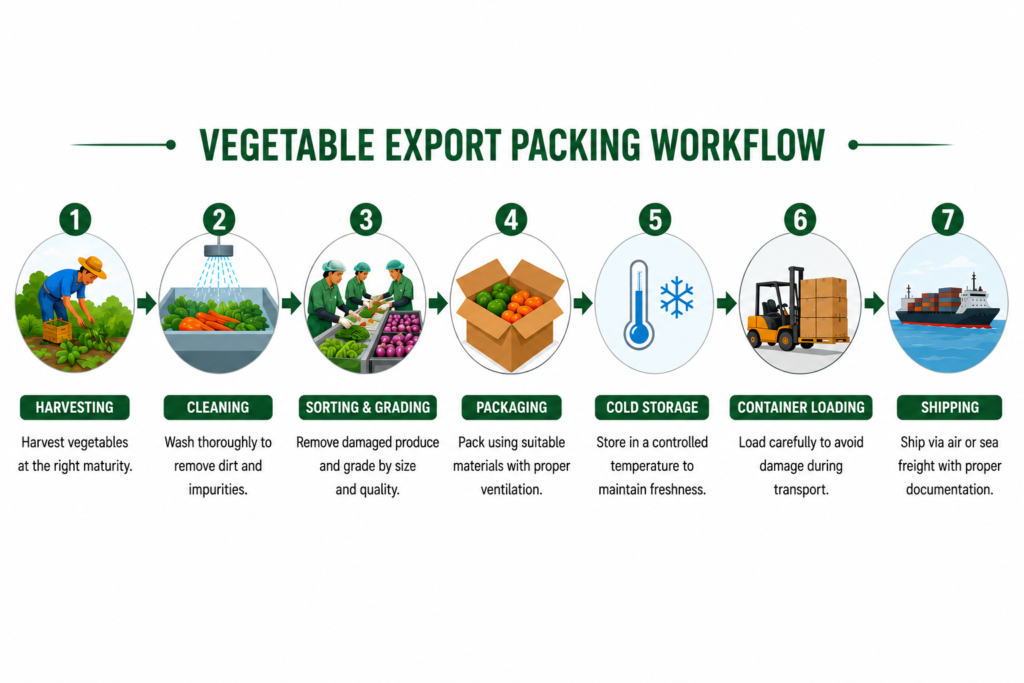
Export Packaging Workflow Diagram
flowchart TD
A[Harvesting] –> B[Cleaning]
B –> C[Pre Cooling]
C –> D[Sorting & Grading]
D –> E[Packaging]
E –> F[Labeling]
F –> G[Cold Storage]
G –> H[Container Loading]
H –> I[Export Shipping]
Best Vegetables with High Export Demand
India exports a wide range of vegetables globally.
Popular export products include:
- Onion
- Potato
- Green chilli
- Okra
- Brinjal
- Drumstick
- Cabbage
- Cauliflower
Many fresh potato exporters now focus on customized export packaging to meet Gulf and European market standards.
Similarly, leading vegetables export companies in india are investing heavily in automated grading and cold-chain logistics to remain competitive in 2026.
Documentation Required for Vegetable Export
Essential export documents include:
- IEC Certificate
- APEDA Registration
- Phytosanitary Certificate
- Commercial Invoice
- Packing List
- Bill of Lading
- Certificate of Origin
Proper documentation ensures smooth customs clearance.
Cost Factors in Vegetable Export Packaging
Packaging costs depend on:
- Packaging material quality
- Cold storage requirements
- Labor
- Transportation mode
- Export destination
Premium packaging often reduces long-term losses caused by spoilage and rejection.
Conclusion
Understanding how to pack vegetables for export is essential for maintaining quality, reducing losses, and building long-term international business relationships. Proper grading, temperature control, ventilation, labeling, and advanced packaging technologies all play a major role in successful vegetable exports.
In 2026, buyers expect high-quality produce with professional packaging standards. Exporters who invest in strong packaging systems gain better market trust, higher profits, and repeat international orders.
For businesses looking to grow globally, Asia Flock Enterprises provides valuable insights, export guidance, and industry knowledge to help exporters succeed in competitive international markets.
Suggested Blogs to Read
FAQs
How to export fruits from India to other countries?
To export fruits from India, businesses must obtain an IEC code, APEDA registration, proper packaging materials, phytosanitary certificates, and comply with destination country import regulations. Maintaining cold-chain logistics and export-quality grading is essential for successful fruit exports.
Profit margin in vegetable export business
Profit margins in vegetable exports vary depending on the product, season, destination country, and logistics costs. On average, exporters can achieve margins between 15% to 40% with proper sourcing, packaging, and buyer networks.
How to export vegetables from India to other countries
Vegetable export involves sourcing quality produce, grading, cleaning, packaging, cold storage, documentation, customs clearance, and international shipping through sea or air freight. Exporters must also comply with food safety and import regulations of the target country.
How to pack vegetables for export in india
Vegetables should be cleaned, pre-cooled, sorted, graded, and packed using ventilated cartons, mesh bags, or modified atmosphere packaging. Proper labeling, temperature control, and moisture management help maintain freshness during export transit.