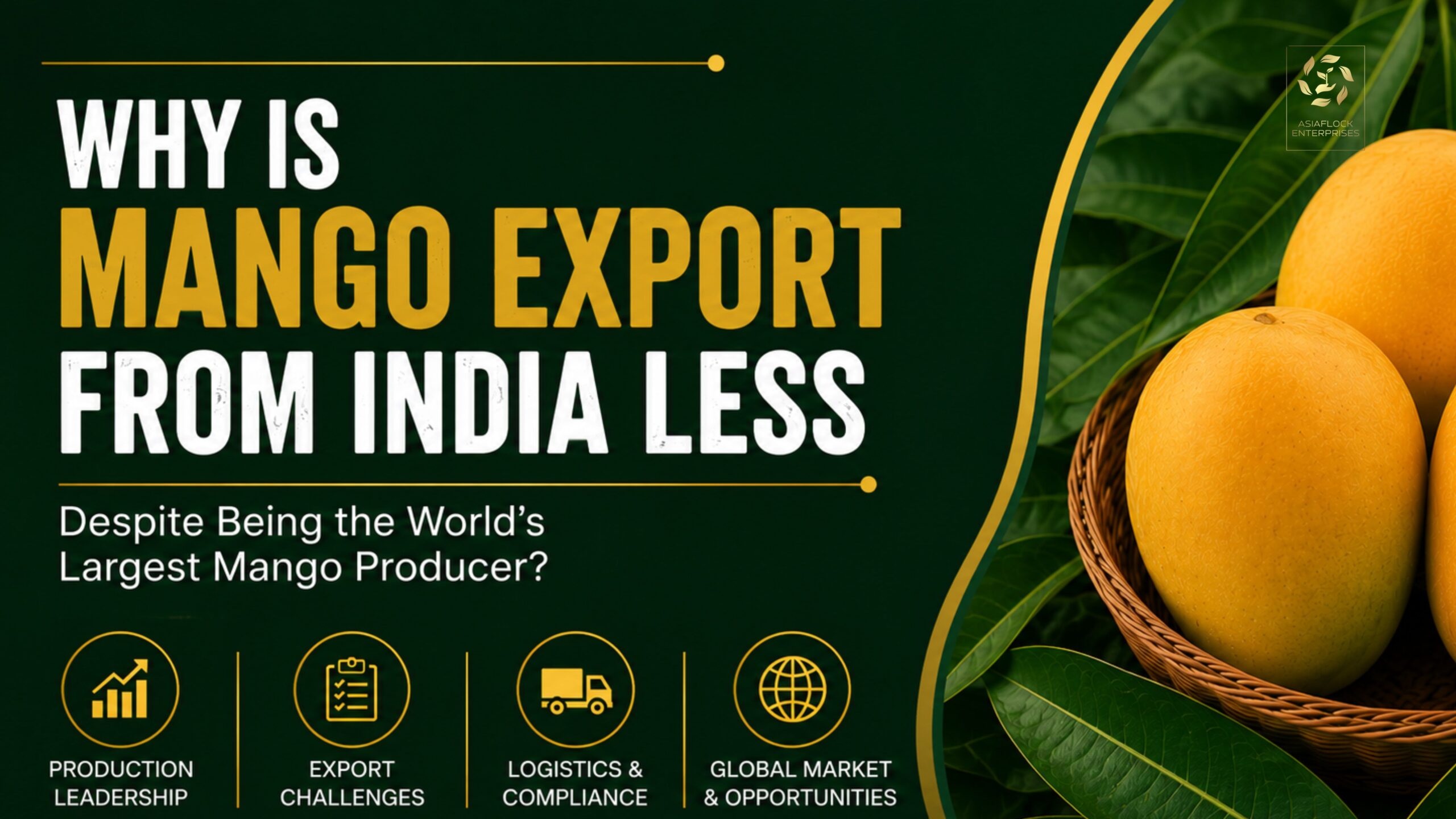

India is synonymous with mangoes. From the rich sweetness of Alphonso to the distinctive flavour of Dasheri, Langra, Kesar, and Banganapalli, Indian mangoes enjoy worldwide recognition. Yet, despite producing more mangoes than any other country, mango export from India remains surprisingly low.
The latest data paints a striking picture. India produced around 22.4 million tonnes of mangoes in 2023–24, accounting for nearly 43–45% of global production. However, exports stood at only 32.10 thousand tonnes, which is roughly 0.15% of the country’s total output.
At first glance, this may seem like a missed opportunity. In reality, the reasons go far beyond production. Strong domestic demand, strict international regulations, infrastructure gaps, and supply chain challenges have collectively limited the growth of mango export from India.
Let’s explore why India, despite being the world’s largest mango producer, exports only a tiny fraction of its harvest.
India Dominates Global Mango Production
India has held its position as the world’s largest mango producer for decades. The country contributes nearly half of global mango production, thanks to its favourable climate, diverse agro-climatic zones, and hundreds of commercial mango varieties.
Major mango-producing states include:
- Andhra Pradesh
- Uttar Pradesh
- Bihar
- Gujarat
- Karnataka
- Telangana
- West Bengal
Among them, Andhra Pradesh and Uttar Pradesh together contribute a significant share of India’s annual production.
However, high production alone does not guarantee high exports. Unlike many agricultural exporters that depend heavily on overseas markets, India has something equally powerful—a massive domestic consumer base.
Strong Domestic Demand Leaves Little for Export
The biggest reason of mango exports from India remains low is simple: Indians consume most of the crop.
Mango is deeply woven into India’s food culture. During the summer season, demand surges across households, fruit markets, supermarkets, restaurants, and food processing units. Premium varieties often sell quickly within the domestic market without exporters having to compete for supply.
For farmers and traders, selling locally is usually the easier and safer option. Domestic buyers offer:
- Faster payments
- Lower transportation costs
- Minimal documentation
- No export certifications
- Reduced risk of shipment rejection
Since mangoes are highly perishable, many growers prefer selling within India rather than navigating the lengthy export process.
In other words, India is not just the world’s largest producer of mangoes—it is also one of the world’s largest consumers.
Strict Export Regulations Make International Trade Difficult
While demand exists for Indian mangoes in countries such as the UAE, the United Kingdom, the United States, Japan, and several European nations, exporting fresh mangoes involves far more than simply packing fruit into cartons.
Most importing countries enforce stringent sanitary and phytosanitary (SPS) regulations to protect local agriculture from pests and diseases.
Exporters often need to comply with requirements such as:
- Maximum pesticide residue limits
- Orchard registration
- Product traceability
- International packaging standards
- Phytosanitary certification
- Irradiation treatment
- Hot water treatment
- Vapour heat treatment
Even minor lapses in documentation or treatment procedures can result in shipments being rejected or suspended.
Recent incidents involving export disruptions to premium markets such as the United States and Japan demonstrate how a single compliance issue can affect exporters financially and damage India’s reputation in international markets.
Logistics and Cold Chain Infrastructure Remain Major Challenges
Fresh mangoes have a limited shelf life. Every stage – from harvesting and grading to packing, transportation, and shipping, must be carefully managed to maintain fruit quality.
This is where mango export from India faces significant structural challenges.
Many production regions continue to struggle with:
- Limited cold storage facilities
- Insufficient packhouses
- Inadequate refrigerated transport
- Limited treatment facilities
- Weak post-harvest handling systems
Delays anywhere in the supply chain can reduce fruit quality before shipments even reach overseas buyers.
Post-harvest losses remain a major concern. Poor grading, improper ripening practices, unsuitable packaging, and inconsistent temperature control can significantly reduce export-quality produce.
Growing more mangoes alone will not increase exports unless the supporting infrastructure also improves.
Quality and Productivity Continue to Affect Export Competitiveness
Consistency matters in international markets.
Global buyers expect uniform fruit size, colour, sweetness, appearance, and shelf life. Unfortunately, maintaining that consistency across millions of small farms remains a challenge.
India’s average mango productivity was around 9.72 tonnes per hectare in 2023, lower than several competing exporters such as Mexico, Brazil, and Pakistan.
Weather variability further complicates production. Heatwaves, unseasonal rainfall, pest outbreaks, and irregular flowering can all affect fruit quality and annual export availability.
Because production is concentrated in a handful of states, local weather disruptions or operational issues at treatment facilities can quickly influence export volumes.
Export Markets Are Concentrated in a Few Countries
Another reason mango export from India remains limited is its dependence on a relatively small number of international markets.
The United Arab Emirates is India’s largest destination for fresh mango exports, followed by markets including:
- United Kingdom
- Nepal
- United States
- Kuwait
- Qatar
While these markets generate valuable demand, relying heavily on a few destinations creates additional risk.
Changes in import regulations, freight costs, geopolitical tensions, or shipping disruptions can quickly reduce export volumes.
The recent Red Sea shipping disruptions, for example, increased transportation costs and created uncertainty for exporters shipping fresh produce to overseas markets.
Diversifying export destinations would make India’s mango export industry more resilient over the long term.
Processed Mango Products Offer the Biggest Export Opportunity
Although fresh mango exports remain limited, processed mango products present enormous growth potential.
Products such as:
- Mango pulp
- Mango puree
- Mango juice
- Concentrates
- Dried mango slices
- Mango powder
- Jams and preserves
are easier to transport, have a much longer shelf life, and generally face fewer quarantine-related restrictions than fresh fruit.
India already performs well in processed mango exports, with mango pulp contributing a significant share of overall export earnings.
As global demand for processed fruit ingredients continues to grow, value-added products offer one of the most practical ways to increase the overall value of mango export from India.
Rather than focusing solely on fresh fruit, expanding processing capacity can help India reach more international markets while reducing losses from perishability.
What India Needs to Increase Mango Export from India
India has the production capacity to become a much stronger player in global mango trade. However, achieving that goal will require improvements across the entire export ecosystem.
Some of the most important priorities include:
- Expanding cold chain infrastructure
- Establishing more export-grade packhouses
- Increasing accredited testing laboratories
- Improving irradiation and treatment facilities
- Strengthening farmer training on global quality standards
- Enhancing traceability systems
- Promoting sustainable and eco-friendly packaging
- Encouraging value-added mango processing
- Diversifying export destinations beyond traditional markets
Collaboration between farmers, exporters, government agencies, and logistics providers will be essential to unlock India’s full export potential.
Conclusion
India’s low mango export from India figures are not the result of limited production. In fact, the country produces more mangoes than any other nation in the world.
The real challenge lies in balancing overwhelming domestic demand with the complex requirements of international trade. Strict quality standards, compliance costs, cold chain limitations, post-harvest losses, and dependence on a few export markets all restrict the growth of fresh mango exports.
Despite these obstacles, the future remains promising. Investments in modern infrastructure, better supply chain management, stronger traceability, and value-added processing can significantly improve India’s position in the global market.
With the right policy support and industry-wide collaboration, mango export from India has the potential to grow far beyond its current share, allowing the world’s largest mango producer to become one of the world’s leading mango exporters as well.
FAQs:
1. Why is mango export from India so low?
Most mangoes are consumed within India, while exports face strict quality, logistics, and regulatory requirements.
2. Which country imports the most mangoes from India?
The UAE is the largest importer of Indian mangoes, followed by the UK, the US, Nepal, Kuwait, and Qatar.
3. What are the biggest challenges in mango export from India?
Cold chain gaps, post-harvest losses, strict export standards, and high logistics costs are the main challenges.
4. Which Indian mango varieties are exported?
Popular export varieties include Alphonso, Kesar, Banganapalli, Dasheri, Langra, and Chausa.
5. How can India increase mango exports?
By improving cold storage, export infrastructure, quality standards, and promoting value-added mango products like pulp and puree.